Summary and synthesis: identifying the main theme or themes; summarising ideas and information from a single text; synthesising from more than one text
This study guide focuses on Assessment Objective 1 (AO1): the ability to identify explicit and implicit information, summarise ideas concisely, and synthesise evidence from multiple texts. These are foundational reading skills tested across all GCSE English Language specifications.
Study Notes
Overview
Summary and synthesis are core reading skills assessed under Assessment Objective 1 (AO1). While they are often tested together, they require slightly different approaches. Summarising requires you to distill the most important information from a single text into your own words. Synthesising requires you to weave together ideas from two or more texts to show how they connect, agree, or differ on a shared theme.
The Podcast
Listen to this 10-minute podcast episode for a comprehensive overview of summary and synthesis skills, including examiner tips and a quick-fire recall quiz.
Reading Skills: Summary
Identifying Explicit and Implicit Information
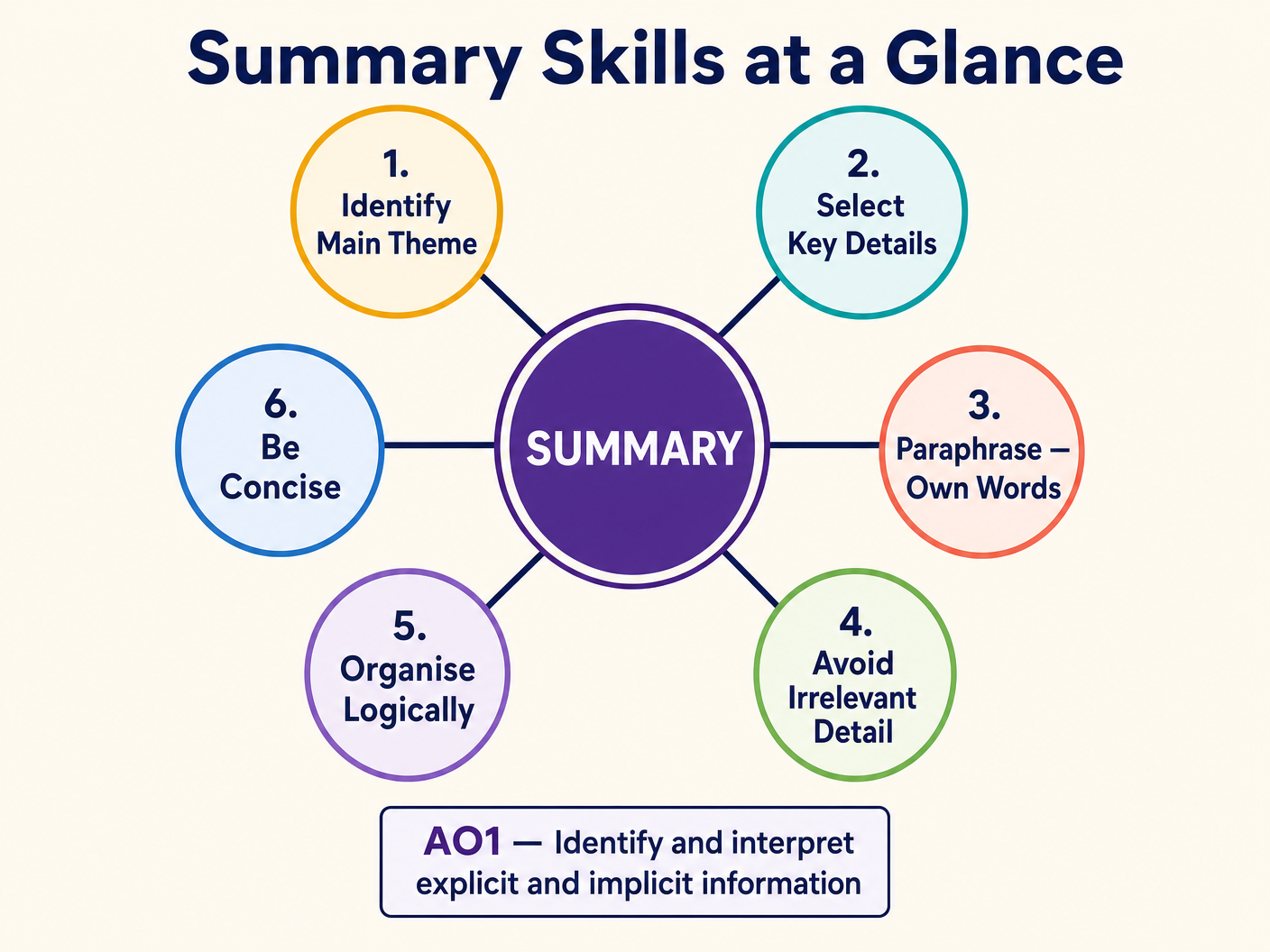
To summarise effectively, you must be able to locate both explicit and implicit information.
- Explicit Information: Information that is stated directly in the text. (e.g., 'The train arrived at 8:00 AM.')
- Implicit Information: Information that is suggested or implied, requiring you to read between the lines. (e.g., 'He paced the platform, checking his watch every ten seconds,' implies he is anxious or running late.)
Examiners reward candidates who can identify both. If you only spot explicit details, your summary will be superficial.
The Summary Process
- Read the Question Focus: What exactly are you being asked to summarise? Highlight the key words in the question.
- Scan and Select: Read the text, highlighting 4-6 key points that directly answer the question.
- Paraphrase: Write your summary in your own words. Do not copy chunks of text. Copying shows you can read, but paraphrasing shows you understand.
- Be Concise: A summary should be shorter than the original text. Omit minor details, long examples, and repetition.
Reading Skills: Synthesis
What is Synthesis?
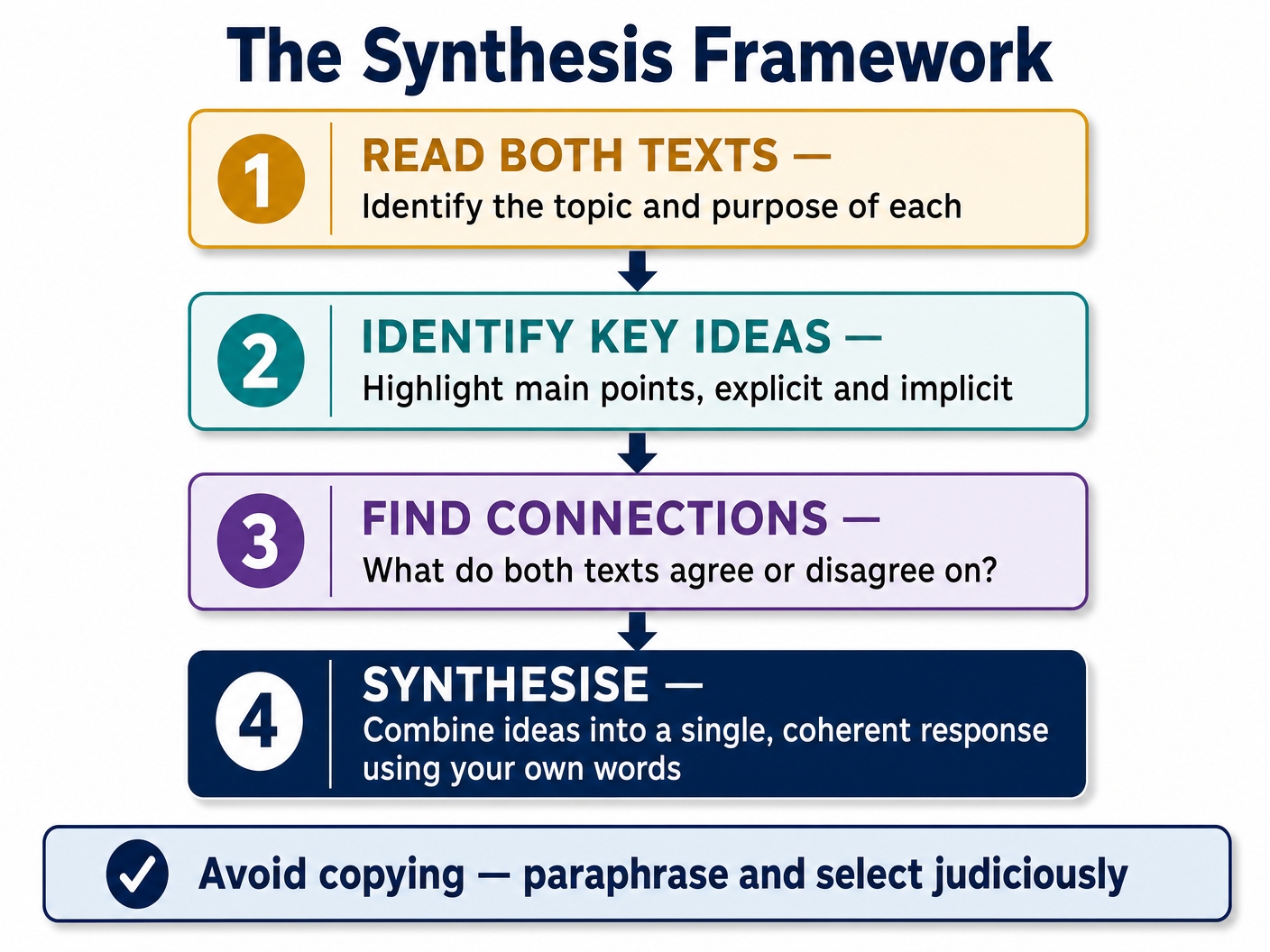
Synthesis means bringing together information from more than one text into a single, unified response. You are not writing about Text A and then writing about Text B separately; you are weaving them together around a shared idea.
The TICS Method for Synthesis
To ensure you are truly synthesising and not just summarising separately, use the TICS method for your paragraphs:
- T - Topic: State the shared idea or theme.
- I - Idea from Text A: Explain what the first text says about this.
- C - Connection: Link it explicitly to Text B using a connective phrase.
- S - Synthesis point: Draw a conclusion about what both texts together tell us.
Essential Connective Phrases
To signal to the examiner that you are synthesising, you must use connective phrases:
- Agreement/Similarity: 'Both texts suggest that...', 'Similarly, Text B presents...', 'Like the writer of Text A, the author of Text B believes...'
- Difference/Contrast: 'While Text A focuses on..., Text B takes a different approach by...', 'In contrast to Text A, Text B suggests...', 'However, Text B offers a different perspective on...'
Writing Skills: Applying AO1 to Your Own Writing
While AO1 is a reading objective, the skills of summary and synthesis are crucial for your writing tasks (AO5 and AO6).
Planning and Organising Ideas
When writing a transactional piece (like an article or a speech), you must organise your ideas logically. The ability to synthesise your own thoughts—grouping related ideas together into coherent paragraphs—is what separates a clear, convincing argument from a disjointed ramble.
Being Concise and Clear
The skill of summarising teaches you how to be concise. In your own writing, avoid unnecessary repetition and 'waffle'. Make your point clearly, develop it with a specific detail or technique, and move on.
Interactive Diagrams
2 interactive diagrams to visualise key concepts
Conceptual Flow Outline
Exam Approach Flowchart for Summary and Synthesis
Conceptual Flow Outline
Mark Scheme Progression for AO1 Summary/Synthesis Tasks
Worked Examples
3 detailed examples with solutions and examiner commentary
Practice Questions
Test your understanding — click to reveal model answers
Read the short paragraph below. Summarise what the writer thinks about modern technology. (3 marks)
'Every everywhere I look, people are staring at small glowing rectangles. We have the sum of human knowledge in our pockets, yet we use it to look at pictures of cats and argue with strangers. The art of conversation is dying, replaced by the convenience of the text message.'
Hint: Find three distinct points the writer makes and put them in your own words.
Read Text A (an article about a flood in 2020) and Text B (a diary entry about a flood in 1953). Summarise what both texts suggest about the impact of the floods on the local community. (8 marks)
Hint: Use the TICS method. Find similarities in how the communities reacted or suffered.
Read Text A (a review of a new fast-food restaurant) and Text B (an essay on healthy eating). Synthesise the writers' attitudes towards modern diets. (10 marks)
Hint: Focus on 'attitudes'—how do the writers feel? Use connective phrases to contrast their views if they differ.
Identify two explicit details and infer two implicit details from the following sentence: 'The headteacher sighed heavily, rubbing her temples as she stared at the mountain of paperwork on her desk at 7:00 PM on a Friday.' (4 marks)
Hint: Explicit = stated facts. Implicit = what those facts suggest about her feelings or situation.
Read the text about a difficult journey. Summarise the challenges the writer faced. Write no more than 50 words. (5 marks)
Hint: The word count limit forces you to be ruthless. Omit all adjectives and examples; stick to the core facts.